
Why Rodent Droppings Are Only the Tip of the Iceberg
If you have recently spotted a handful of small droppings behind your appliance or in a cupboard, you might be tempted to shrug it off. “Just one mouse,” you think. In my experience at Go Away Pest & Wildlife Control Ltd., seeing rodent droppings is often the first visible clue of a much larger problem. In the Lower Mainland, Fraser Valley and across the Thompson-Okanagan region we are seeing more properties than ever where what looked like a small issue turned into full-blown house guests. Let’s look at what droppings tell us, why you need to act and how we apply a long-term, eco-friendly solution you can trust.
Rodents such as mice or rats are opportunistic. They need food, water and shelter to survive, and once they find gaps into a structure, they will move in. The presence of droppings is a clear sign they are already inside and active. The provincial resource from the Government of British Columbia notes: “Rats and mice can also squeeze through very small holes or cracks … look for any gap or hole inside or outside your building that is 6 mm (1/4 inch) or bigger.”
In my residential work I frequently find older homes, especially in winter, where rodents had been chewing inside wall voids, nesting, and leaving droppings. The homeowner often notices only when the damage is already significant. For example, during one winter in an older home we found a major rat infestation with chewing inside numerous walls, ceiling cavities and voids. The entry point was a 2-inch gap on the exterior. Once that was sealed, the rest of the job fell into place.
Droppings are more than just unsightly. Once rodents are inside your building:
- They can damage insulation, wiring and structure by chewing and nesting in hidden spaces.
- They contaminate food and surfaces with urine and feces, increasing health risks for children, pets and vulnerable people.
- In the Lower Mainland and Fraser Valley climate, moisture, warm basements and older crawl spaces make many homes inviting to rodents seeking shelter as temperatures drop.
Ignoring droppings today often means a much larger bill tomorrow for repair, cleaning or ongoing control.
At Go Away Pest & Wildlife Control we believe in reason, not quick fixes. Our approach emphasizes:
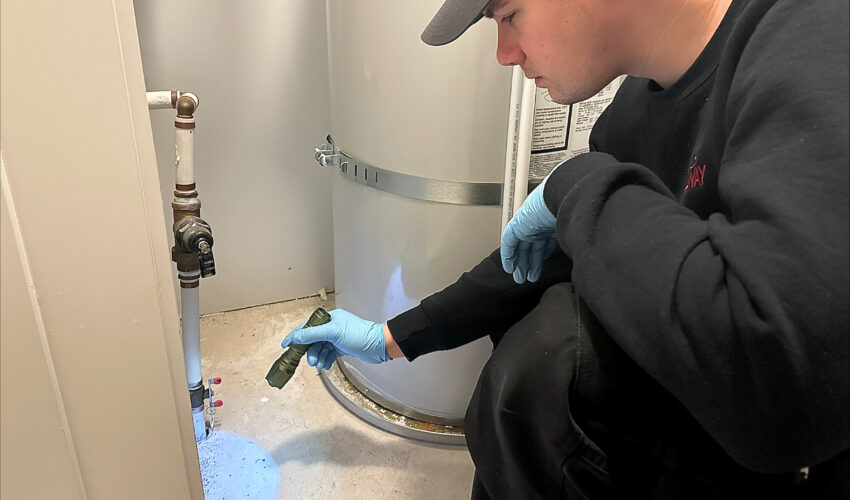
- Inspection: We look for droppings, gnaw marks, grease trails, nesting materials and entry points.
- Exclusion work: We seal the building so rodents cannot keep coming back. That means using steel wool or wire mesh for specific gaps, installing rodent-proof door sweeps and ensuring vents, pipes and openings are protected rather than relying only on poison.
- Eco-friendly control: We minimize the use of rodenticides and reserve them only when necessary.
- Warranty and follow-up: We provide a 3-month warranty on treatments. If any activity returns in that period, we revisit and fix the issue.
- Client education: We advise clients on reducing food and water sources, sealing bins, keeping pet food indoors and trimming overhanging vegetation.
This layered method ensures the droppings you spotted are treated as the symptom, not the problem.
Here is one of my recent real-life cases.
An older single-family home in the Lower Mainland: the homeowner noticed droppings late in winter and even some scratching noises behind walls. On inspection, we found numerous chew marks on wallboards, wiring, ceilings and in the crawl space. We traced it to one obvious 2-inch gap on the exterior, just large enough for rats to enter. Once we sealed that gap, installed proper exclusion measures such as steel wool, mesh and door sweeps, and set appropriate traps, the infestation stopped. Two follow-ups over the next eight weeks showed zero new activity. The homeowner’s summary: “We thought it was just one mouse. Turns out we almost missed rats living in our walls.”
This case shows the importance of early detection, exclusion first and the value of a warranty-backed treatment.
If you see rodent droppings in your home, do not wait. Here are three quick tips:
- Seal the food: ensure bins are tightly closed, pet food is stored inside and leaks are fixed.
- Check for gaps: even a ¼ inch hole can let mice in, and a ½ inch can let rats in.
- Call in professional help: early inspection and exclusion save you money and hassle later.
For trusted eco-friendly rodent control across the Lower Mainland, Fraser Valley and Thompson-Okanagan regions, call Go Away Pest & Wildlife Control today. We will perform a thorough inspection, outline the gaps, trap where needed and back our work with a 3-month warranty. Let’s keep your home rodent-free for the long term.


